The Shanghai Municipal Bureau of Statistics recently released the results of a sample survey of population changes in 2022. According to the survey, the birth rate in Shanghai continues to decline, and the survey data of "the most important reason for not planning to give birth (the next child)" and "the ideal number of children" also appear. The reporter learned from the Shanghai Municipal Bureau of Statistics that the data was first published in this statistical report.

The main reason for not planning to give birth (the next child) Source: Shanghai Statistics Bureau
Relevant data show that among the permanent residents in Shanghai, the most important reason for not planning to give birth (the next child) is "satisfied with the status quo", accounting for nearly half, accounting for 41.8%, followed by "high cost of raising and heavy economic burden", accounting for 28.5%, and "age or physical reasons" accounting for 13%, followed by "other", "unattended children" and "hope to live".
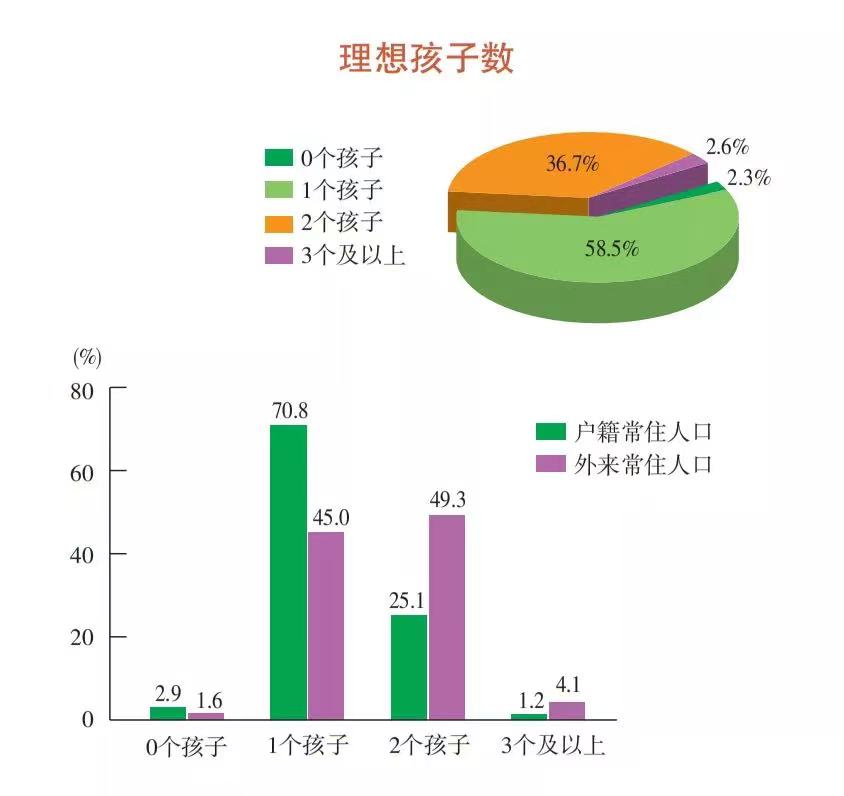
In the survey of "ideal number of children", one child still accounts for the majority of the ideal number of children in Shanghai, accounting for 58.5%. The proportion of two children, three or more children is 36.7% and 2.6% respectively, and the proportion of ideal children is 2.3%. Over 70% of the permanent residents in Shanghai want to have one child, and nearly half of the foreign permanent residents want to have two children.
Regarding the release of this new data, Peng Xizhe, a senior professor of liberal arts at Fudan University and executive vice president of the Development Research Institute, told the The Paper that the National Development and Reform Commission and other 17 departments issued the Guiding Opinions on Further Perfecting and Implementing Positive Maternity Support Measures last year, demanding that the establishment of a maternity support policy system be accelerated. The issue of "one old and one young" is also one of the most concerned issues of the people. Therefore, it is natural for the Bureau of Statistics to investigate the public’s discussion on "small" and respond to the people’s most concerned issues through data.
Expert: The problem of insufficient internal driving force of fertility is prominent, and the data still needs further study.
"We often say that people of childbearing age do not want to be born because of the heavy burden of parenting. If you look at the data carefully, the proportion is not very high." Peng Xizhe pointed out that the release of the data may provide a reference for relevant departments to formulate the next supporting policies. "For example, the proportion of children who are left unattended is not high. We promote the construction of supporting facilities for 0-3-year-old nursery services and 3-6-year-old preschool education, mainly to alleviate the problem of unattended children. Therefore, we need to study this data more deeply in order to explore this part of the service more reasonably and effectively. How to implement and distribute it next, or where we will focus next. "
However, Peng Xizhe also pointed out that the option of "satisfied with the status quo" in the data has a slightly vague directionality, or it may present a more detailed analysis in the future release. "It is difficult for us to judge whether the person who chooses this option is Dink, has a child or two children, so there is no desire to have the next child. In fact, the situation and demands of these groups of people are very different, and it is difficult for us to judge more specific reasons and make accurate ones.
Peng Xizhe believes that the difference in the number of ideal children between the permanent resident population in Shanghai and the permanent resident population in Shanghai also reflects the difference in fertility willingness among regions. For example, areas with a large permanent resident population in Shanghai, such as Henan, Anhui, and northern Jiangsu, may prefer two children conceptually. "It is worth noting that fertility willingness does not mean that they are actually raised in Shanghai, and many migrant workers will choose to return to their hometowns to give birth, which will also cause problems for many left-behind children."
Kenso, assistant president of East China Normal University, is an expert in the field of demography. She told The Paper that the proportion of people who are "satisfied with the status quo" is close to half, and some of them are beyond her expectation. During this year’s two sessions of the National People’s Congress, Kenso pointed out that the problem of fertility should be discussed in two categories: those who don’t want to have children and those who don’t want to have children. In her view, the people who are satisfied with the status quo should be highly consistent with those who don’t want to have children, which reflects the problem of insufficient internal driving force of fertility in current society.
"The problem of not wanting to have children is very complicated, and it should be the overall reason, such as the higher and higher cost of raising children, the smaller and smaller benefits that childbirth brings to families, and your own considerations in opportunity costs. If you combine them, you will not want to have children or not want to have more children." Kenso said.
Kenso pointed out that "people who want to have children but dare not have children" can also formulate policies based on problems, but it is difficult to stimulate fragmented policies in view of the problem of insufficient internal drive, so efforts should be made to establish an integrated fertility support system. During this year’s National Conference, she submitted the Proposal on Improving the Integrated Fertility Support Policy System for Marriage, Fertility, Parenting and Education, calling for long-term integration according to the diversified fertility needs of the masses. "The popularization of fertility culture, the improvement of employment environment, the construction of female-friendly baby-care facilities, male parental leave, etc., we must look at and promote these issues in an all-round way. The effect that the fragmented policy can play at this stage is not so ideal. This is the problem of fertility I have seen." Kenso said.
Obstetrician: The childbearing age of women is being postponed. It is recommended that women give birth at around 30 years old.
The fertility problem is also intuitively reflected in the data that the birth rate continues to decline. The reporter noted that the table of natural changes of permanent residents in Shanghai from 2010 to 2022 showed that by the end of 2022, the birth rate had dropped to 4.4, the lowest in the past decade.
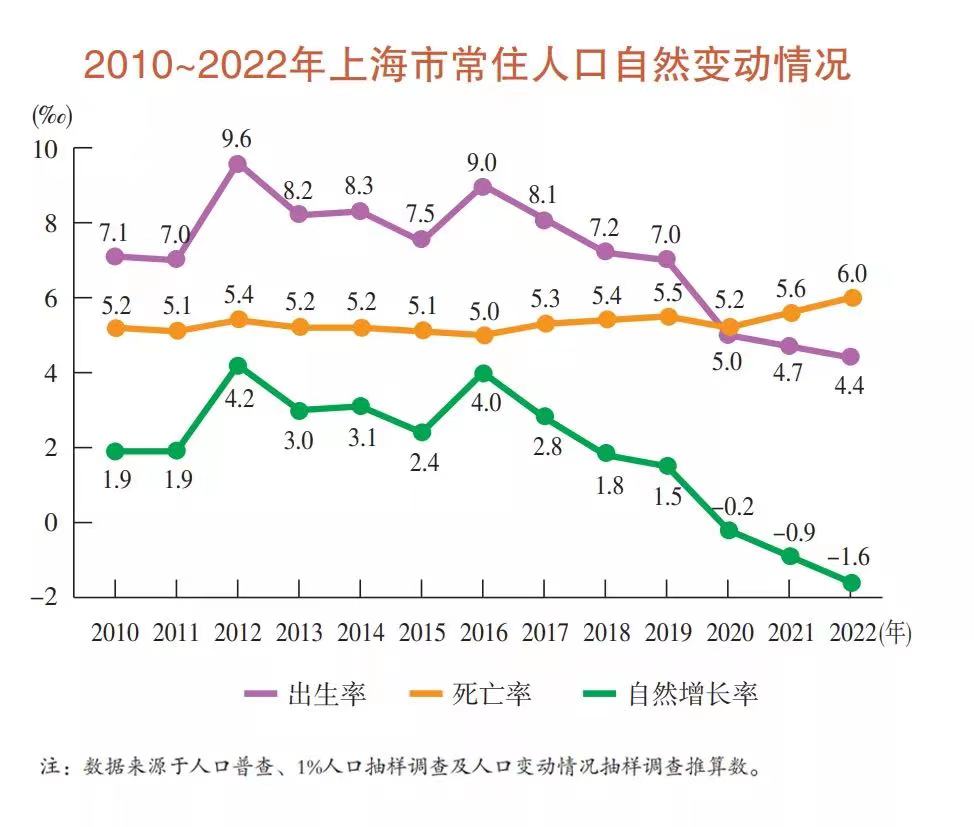
Table of natural changes of permanent residents in Shanghai from 2010 to 2022.
Huang Yiying, director of obstetrics in the West Hospital of Shanghai No.1 Maternal and Infant Health Hospital, told The Paper that as an obstetrician, she noticed that there was indeed a decline in delivery in clinic in recent years. The hospital’s delivery volume ranks first among all major obstetric hospitals in Shanghai all the year round and ranks in the forefront of the country, and is called "the cradle of Shanghai" by the citizens. Previously, with the liberalization of the national comprehensive two-child policy, the hospital ushered in the highest delivery volume in 2016, reaching nearly 34,000 a year. "In recent years, there has been a downward trend in the number of deliveries, ranging from 25,000 to 30,000. In 2022, the number of deliveries in hospitals reached more than 26,000."
Not only that, Huang Yiying also felt that because the childbearing age of women is being postponed, the age of giving birth to the first baby is correspondingly delayed. Some women, especially women in the workplace, will report the great pressure to take care of their children. The question of "Who will take care of the children" is the main question for women of childbearing age to think about.
"If some women have their first child at the age of 35, then if they want to have two children, under normal circumstances, if they have a caesarean section, they need to be separated by at least one and a half years. In this case, if they are over 35, they will be classified as elderly women, and the risk of childbirth may be high. If the pregnant woman has basic diseases such as hypertension and diabetes, it will be more cautious to consider giving birth to two children. " Huang Yiying said.
Huang Yiying further said that with the continuous development of medical technology, technically speaking, it is feasible to give birth at an advanced age, especially in a place with abundant high-quality medical resources like Shanghai. However, advanced age is accompanied by the deterioration of the function of the heart and the whole body, and the burden of advanced pregnancy on the human body will increase. During pregnancy, some potential diseases may appear, and the proportion of infertility and abortion will increase. Pregnancy may affect the safety of pregnant women themselves. Therefore, the whole process of pregnancy preparation and birth of new life for elderly women needs the careful escort of professional maternity medical team.
Huang Yiying suggested that women’s childbearing at school age has been repeatedly emphasized in clinic. She suggested that it is best for women to give birth to their first child at around 30 years old, so that they can achieve prenatal and postnatal care. At the same time, if they have plans to give birth to another child, they can also set aside time. "Under normal circumstances, if women give birth to their first baby naturally, considering the lactation period and the recovery time of the body, it is recommended to get pregnant after one year, so that it is relatively good for two babies to be separated by 2-3 years; However, if the first baby is born by cesarean section, it will be regenerated at least one and a half years after cesarean section, which requires a comprehensive examination before giving birth, and may even include reproductive examination, which requires women and their families to give more time to pay attention. At present, we also put forward the concept of providing women with life-cycle health management and services, doing a good job in prenatal and postnatal care, and ensuring the life and health of women and children. "

关于作者