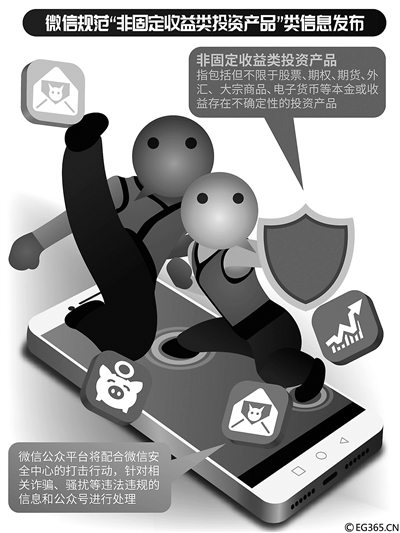
The WeChat public platform announced that from now on, the WeChat public platform will cooperate with the WeChat Security Center to deal with the information of fraud and harassment by recommending "non-fixed-income investment products" such as stocks and futures and WeChat official account. Wechat Security Center reminded that such "stock recommendation" frauds often take advantage of the user’s psychology of wanting to make profits, and the recommendation is entirely based on luck. If the stock goes up, it will follow the dividend (or charge), and the stock will fall without any responsibility.
In the past, it was a telephone recommendation, QQ pull people, and the opening lecture of the stock god. After the rise of the mobile Internet, stock recommenders have turned to the online. Nowadays, in the WeChat group and the live broadcast room, the so-called godfather of A shares and a sister in the stock market are boasting that they can "help you make a fortune in stock trading". The insiders pointed out that no matter how the communication channels change, the routine of swindlers has not changed: first, attract investors’ attention, recommend some good stocks for free, let investors taste the sweetness, invite them to join, and then charge investors a high membership fee. Although the WeChat Security Center began to crack down on WeChat stock recommendation at the end of last year and seized 1,100 illegal accounts, a recent investigation by Beijing Youth Daily reporter found that the phenomenon of WeChat stock recommendation still exists.
case
200,000 has entered the market and is still trapped.
Mr. Song, a stockholder, told a story. A few months ago, someone added him to WeChat, saying that there was a stock recommendation, the account was operated by itself, and the profit was divided into 50-50, and they made up for the loss. "I didn’t pay attention to it. She sent stock information every day. After the close, she said that she would open a ticket today, and it would rise the next day. At noon, she said that it would rise sharply in the afternoon. Occasionally, she also sent screenshots and transfer pictures of other customers making money." I couldn’t resist the temptation. Last month, Mr. Song entered the market with 200,000 yuan, and the first stock, T+1, earned 6,000 yuan. The second stock, which was still rising the next day, fell when the market was not good, and it set him up for half a month and lost more than 10 thousand. Mr. Song had to cut a stock, and as a result, the stock went up when he sold it. If he didn’t sell it, he would soon be untied. The other stock recommended by the recommender is currently being quilted. At this time, Mr. Song suddenly realized: "It seems that I should have been cheated."
But to Mr. Song’s surprise, how did these swindlers accurately predict the tickets that rose the next day and the tickets that rose sharply in the afternoon at noon for several months? In this regard, people familiar with the matter analyzed that they are an organization with certain funds, looking for an unpopular small stock, and the stock that rose the next day was organized by him to throw money in, in order to convince investors that they can really manipulate stocks and cheat investors. What they earn is that 50-50 split.
survey
There are four ways to make money in WeChat stock recommendation.
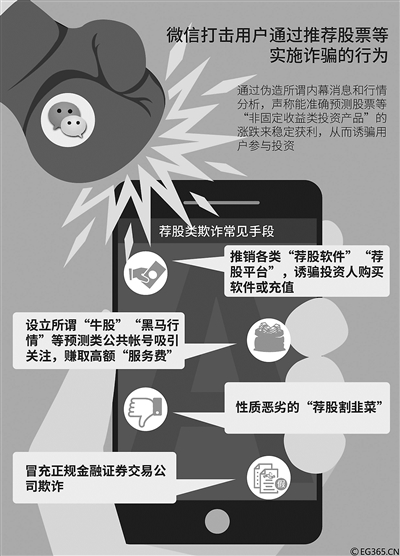
According to a survey conducted by the reporter of Beiqing Daily, the current wechat money-making routines are mainly divided into the following types.
The first category: open a live broadcast room and sell courses. In a stock selection WeChat official account, there is an "exclusive and private exchange circle", which claims that investors can communicate and interact with teachers at zero distance, answer difficult questions, help you to remind of risks, diagnose the stocks in hand and tap the potential stocks in the market. Click to enter, and I was guided all the way to download an APP for stock trading consultation, in which more than a dozen VIP exchange circles were opened, and the names were very loud. What band goddess, Zhi Duo Xing, Sai Zhuge, Gu Hai Qingtian, Shen Operator, A-share godfather and a sister in the stock market could not be confirmed. They tweet on the APP and have their own live broadcast room. However, if fans want to enter his exclusive live broadcast room, they must buy a VIP service card, with a monthly card of 2888 yuan, a season card of 7700 yuan and an annual card of 27700 yuan.
The second category: building stock groups and collecting membership fees. When Ms. Zhu brushed Weibo, she often saw some hot spots, such as ×× stocks, daily solutions, etc. However, after paying attention, the other party automatically replied to her and said, "Please add my assistant WeChat to lead the latest strong bull stock layout, operation strategy, individual stock analysis and market analysis in January."
Soon, Ms. Zhu found the WeChat public account of this "bull stock". Although the tweet in the public account was still a month ago, the slogan was very attractive: "Sweep WeChat and you can immediately lead the bull stock." It is also equipped with the QR code of "Teacher". After being pulled into this stock trading group, the stocks recommended by the "teachers" inside did rise sharply every day, which made her very tempted. But soon, the "teacher" asked her to charge 18,000 yuan for three months. It is understood that membership fees vary in price, and there is no standard, such as 39,800 yuan, 68,800 yuan and 98,800 yuan. Anyway, the figures are very auspicious.
The third category: selling stock recommendation software. Another stockholder, Lao He, paid a membership fee of 15,000 yuan after purchasing a stock recommendation software and enjoyed the so-called stock recommendation service. After suffering losses, he was told that the software version was not high enough and he needed to pay another 16,000 yuan to upgrade. After Lao He recovered the fees, he invested again but suffered losses. These teachers all disappeared without a trace. As a result, Lao He was kicked out of the group, his phone was turned off, and WeChat was blacked out.
The fourth category: cooperation and sharing. As the above-mentioned shareholder Mr. Song said, this method is more confusing. The recommender said that he would charge a certain percentage of your profit as a reward, but the recommender often only shares your income, but will not help you share the loss. In fact, the real purpose of the liar is the membership fee, because the stock recommender will tell the shareholders that they have no right to know which stock to buy and sell that day. Only after being included in the membership system can they follow the layout of the trader. At this time, the swindler will persuade the investors that the membership fee is not worth mentioning relative to the income.
risk
The qualification certificate of "Quantification Master" is "no such person"
For investors, the risk of recommending shares by WeChat is extremely high. According to a survey conducted by the reporter of Beiqing Daily, once investors believe in the routine of "WeChat recommending stocks", it is possible that tens of thousands or hundreds of thousands of stocks will be quilted or even directly defrauded of huge amounts of money.
Risk 1: the identity of the stock god is suspicious. In a stock investment APP, a quantification master and investment consultant named Hu showed his certificate number: S1080617060014. However, the reporter of Beiqing Daily inquired about "Information of Practitioners of China Securities Industry Association", but it showed that the number did not exist. In the survey, the reporter of Beiqing Daily also noticed that no matter which stock recommendation group you are in, the big coffees inside are very good. Self-introduction can be called the level of stock gods. He packaged himself as a stock market golden eye and a stock market beacon. There is a "Jian Xia" who said that his performance has achieved a rate of return of 784% since 2014. In fact, he copied and pasted the contents of Oriental Fortune Network and Sina Finance every day, or took out some daily limit stocks to talk about the feeling of rising. Never comment on potential stocks before the market. Anyway, if the market falls, it will reduce the position, if it rises, it will increase the position, and the success rate will be half-to-half. If it is right, it will show off, and if it meets a daily limit stock, it will blow it to the sky.
Risk 2: membership fee. Senior stock speculators said that no matter how the communication channels change, the stock recommendation routine has not changed: first, attract investors’ attention, recommend some good stocks for free, invite investors to join after they taste the sweetness, and then charge investors a high membership fee. More importantly, there is no standard for this member. They will find the right target to upgrade step by step, and let you pay a membership fee of 2,000 yuan first, but after a while, they will fool you: "You can enter our top-earning stock group by paying 200,000 yuan."
Risk 3: cooperation and sharing. Senior stock speculators pointed out that almost 99% of the cooperation shares are the same fraud method: before 9: 30, three stocks that have risen sharply or suddenly rose by about 3% during the bidding time are recommended to defraud novices. Novices are recommended before 9: 30, so they are deceived. After the opening, the three stocks have gone up and down. If they go up, they will be advertised. If they don’t go up, they will say that they have been laid out in advance. Non-users will grasp their own trading points, buy software or add members, and their so-called teachers will provide trading points.
After 9: 30, these group owners will send screenshots of various members, group members and customers to prove that someone has cooperated. For example, the screenshot of the stock given by the group owner is actually sent by another "trust" of their own, just praising themselves. Sometimes a screenshot of the money order will be sent to prove that someone has remitted money. In fact, these remittances are remitted to themselves from their own bank accounts, and then screenshots are taken to achieve the purpose of deception.
Risk 4: Stock trading software. It is reported that in 2016, a large-scale online stock fraud case was cracked in southern China, with more than 30,000 people deceived and the amount involved was more than 400 million yuan. According to the investigation, the criminal suspects set up fake companies overseas, set up servers overseas, and developed agents in China with the so-called software for stock trading. These agents arranged for salesmen to make friends with each other through QQ to attract customers into QQ groups and live video rooms in the name of learning stock trading. Then the agent members play the roles of lecturers, analysts and customers according to the division of labor, touting the stock trading technology of lecturers in the group and inducing customers to use false quotation software.
respond
Wechat officially cracked down on fraud such as stock recommendation.
On the evening of December 18, 2017, the WeChat team of WeChat Security Center announced that it would crack down on users’ fraud by recommending stocks. Wechat said in the announcement that it has recently received complaints from users that some users have committed fraud and harassment by recommending "non-fixed-income investment products" such as stocks and futures. In this regard, the WeChat Security Center issued an announcement, which issued investment advice and "stock recommendation" for WeChat personal accounts. Through the user’s report, more than 120 WeChat groups (according to a group of 500 people, there are nearly 60,000 people in total) have been restricted. Group function processing, and more than 1,100 WeChat accounts have been subject to stepped penalties such as restricting function use or restricting login.
On January 5, 2018, the WeChat public platform announced that from now on, the WeChat public platform will cooperate with the WeChat Security Center to deal with the information of fraud and harassment by recommending "non-fixed income investment products" such as stocks and futures, and WeChat official account. According to the announcement, "non-fixed income investment products" refer to investment products including but not limited to stocks, options, futures, foreign exchange, bulk commodities, electronic money and other investment products with uncertain principal or income.
Wechat Security Center warned that this kind of "stock recommendation" fraud, by forging so-called inside information and market analysis, claims to accurately predict the rise and fall of "non-fixed income investment products" such as stocks to stabilize profits, thus tricking users into participating in investment; In fact, they often take advantage of the user’s psychology of wanting to make profits, and recommend that it is entirely by luck. If the stock goes up, it will follow the dividend (or charge), and if the stock falls, it will not bear any responsibility. This fraudulent profit-making model has seriously damaged the interests of users, and the state has explicitly prohibited such behavior.
point out
It is suspected of breaking the law to recommend a stock company to promise income.
For stock recommendation fraud, the person in charge of the relevant department reminded investors that the stock recommendation companies must be identified: first, we must find out whether they have the qualification of securities investment consulting. The official WeChat of the formal financial website will provide some financial advice and attach a brokerage research report or a package of stock recommendations without charge. Secondly, if you really want to cooperate with the stock recommendation company, you must sign corresponding agreements or contracts to protect your legitimate rights and interests, and you must have a sense of taking risks; Thirdly, if the recommendation company promises the income, it is suspected of breaking the law.
For investors who have suffered losses, the person in charge of the relevant departments said that on the one hand, we should pay attention to retaining and collecting more powerful evidence, such as agreements, contracts, recordings, etc. On the other hand, if you collect good evidence, you can complain to the website of the CSRC or call 12386, or you can solve it through arbitration or litigation. Text/Reporter Zhao Xinpei Photo courtesy/vision china

关于作者